
Why Do Chinese People Tap the Table After Someone Pours Tea?
A silent gesture of gratitude, rooted in dynasties past — known as Kòu Chá Lǐ (叩茶礼), the etiquette of finger-tapping.
A Quiet Thank-You, Spoken in Fingertips
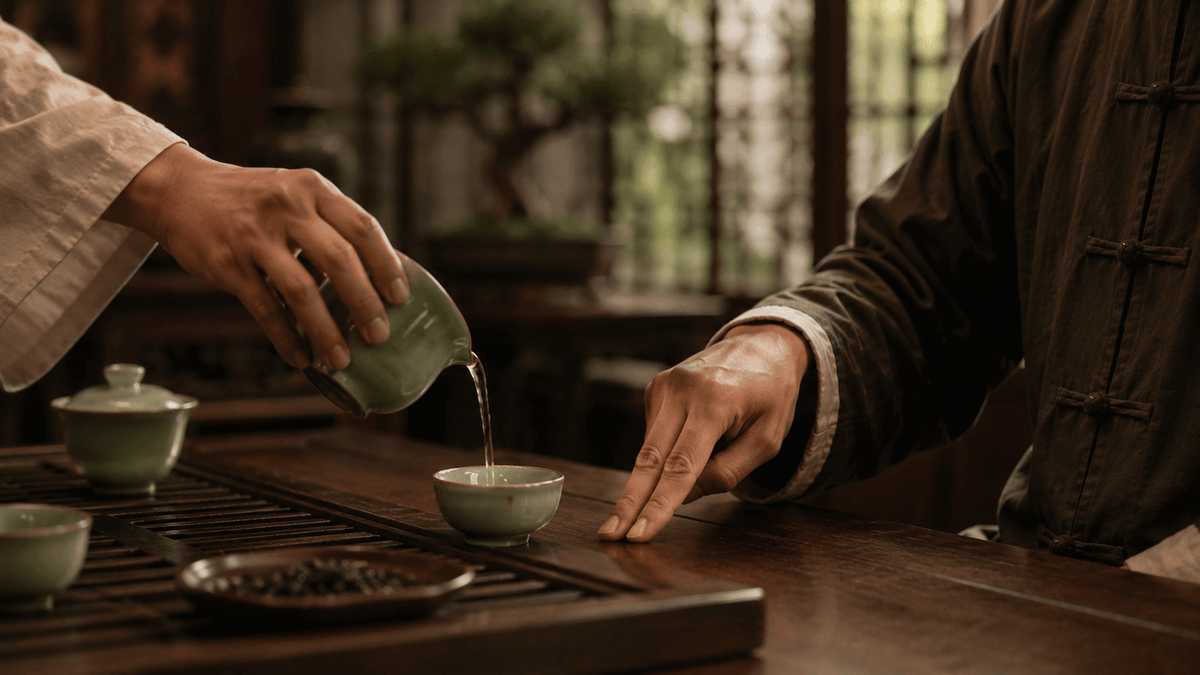
In a traditional Chinese teahouse, you may notice something curious: the moment a host refills a guest's cup, the guest curls two fingers and gently taps the tabletop. No words are exchanged. The host nods, almost imperceptibly. The ritual is complete.
This is Kòu Chá Lǐ — the etiquette of finger-tapping to express gratitude for poured tea. It is a custom practiced across Chinese communities worldwide, from Cantonese dim sum halls in Hong Kong to family gatherings in Beijing. To the uninitiated, it looks like a small, superstitious habit. But within it lies a story of an emperor, his servants, and a clever act of disguise.

An Emperor in Disguise
The most beloved origin of this custom dates to the Qing Dynasty (1644–1912), centering on the Emperor Qianlong — one of China's longest-reigning rulers and an avid traveler who often roamed his empire incognito, dressed as a commoner.
On one such journey through Jiangnan, the emperor and his servants stopped at a teahouse. To maintain his disguise, Qianlong poured tea for his attendants himself — an act that, under imperial protocol, would have required them to drop to their knees and kowtow in gratitude. But a full kowtow would have revealed the emperor's identity to the teahouse patrons.
In a stroke of ingenuity, one servant curled his fingers and tapped the tabletop — a silent kowtow, offered in miniature. The fingers became the bowed head; the table, the marble floor of the imperial court. The emperor understood. The gesture was born.
Whether history or legend, the ritual endures. And over the centuries, a quiet grammar developed around it — the number of fingers used carries its own meaning, calibrated to the relationship between host and guest.
The Grammar of Gratitude
The etiquette follows a simple, elegant logic: the more fingers used, the greater the reverence. Each gesture corresponds to a different relationship — and to confuse them, in older times, would be a quiet social misstep.
Below, the three forms of Kòu Chá Lǐ. Tap any card to see it performed in the ritual below.
To a Junior
When pouring tea for someone younger — a child, a student, a junior colleague — a single tap of the index finger suffices. It is a nod of acknowledgment: "I see your kindness, and I thank you." Simple, but never dismissive.
To a Peer
Among equals — friends, siblings, colleagues of similar station — two fingers tap together: the index and middle, side by side. The two fingers are said to represent the two arms folded in a traditional bow. Mutual respect, offered and received as between kin.
To an Elder
When an elder pours your tea, the response is solemn: five fingers brought together, lightly curled, and the knuckles tapped gently against the table. It is a kowtow in miniature — the full hand bowing as one would bow the whole body. The deepest gratitude, condensed into a single gesture.
Try the Ritual
Pour the tea, then choose your gesture of gratitude. Watch the centuries-old etiquette unfold at your fingertips.
A Living Gesture
In modern China — and in every dim sum restaurant from Hong Kong to San Francisco — the gesture persists. It is no longer about emperors, but about something older and more universal: the quiet acknowledgment that an act of kindness, however small, deserves to be seen.
So the next time someone refills your cup, do not simply say "thank you." Curl your fingers. Tap the table. Let the centuries speak through your fingertips — and let the silence say what words cannot.

In every drop of tea, there is gratitude. In every tap of the finger, a thousand years of memory.

Leave a comment
This site is protected by hCaptcha and the hCaptcha Privacy Policy and Terms of Service apply.